Three Reasons You May be Afraid of Feeling Emotional Pain
And how IFS therapy for trauma can help to welcome pain with confidence and compassion.
A major phase in doing IFS (Internal Family Systems) parts work therapy for trauma is learning how to cope with the emotional pain you may have been detaching from for years or even decades.
Especially in childhood, our psyche copes with emotional pain by detaching from it because it’s overwhelming and we don’t yet have the coping skills to attend to it. Emotional pain can be caused by rejection, abandonment, shame, intense threats or violence, or overwhelming loss. Shame can be caused by benign neglect when caregivers aren’t able to emotionally attune. Our power to detach or dissociate from that pain is part of why our personality forms “parts” in order to get through life. We all do it to various degrees. Multiplicity of mind is a resilient response to emotional adversity.
In the therapy process, as we get closer to directly addressing emotional pain together, some common fears can come up:
The pain will go on forever. A part may be subconsciously imagining that the pain will go on forever once it comes
You don’t know how to cope with pain. You may be assuming you won’t be able to cope. You just can’t imagine getting through it.
Shame may have you believing you “deserve” to feel this pain. When growing up with difficulty getting needs seen or met, children very commonly blame themselves, and shame becomes part of their sense of self and identity. So a part believes you are a bad person and should feel punished. (You aren’t and you shouldn’t.)
How do we work together to help you feel that pain is more approachable?
The starting goal is to build confidence in the belief that there is a kind and nurturing presence available to you who will be there when you feel pain. At first, this presence may be your therapist. But ultimately, we want that person to be a part of you: a kind and compassionate self.
So how do you start to connect with feeling a safe and supportive presence?
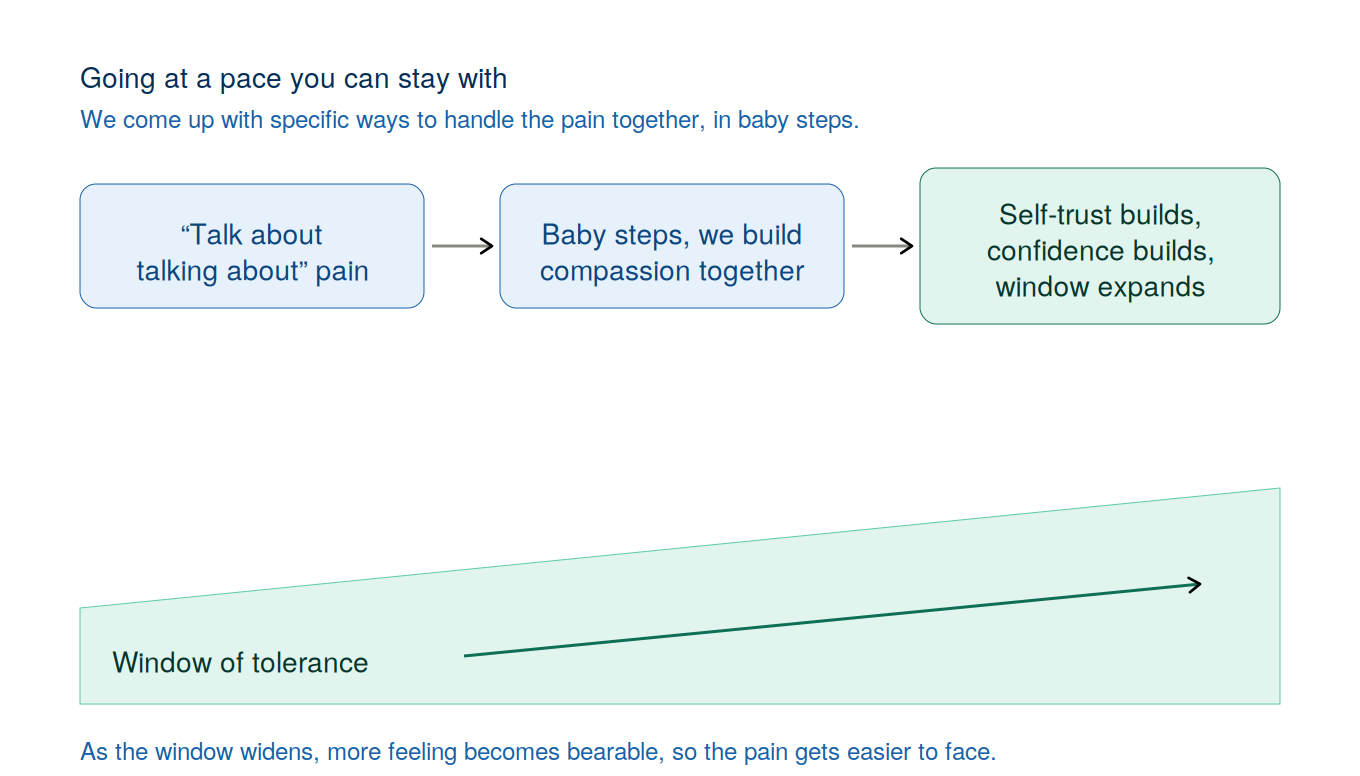
The answer: We talk about talking about the pain. Without actually getting into the specifics of the painful material (usually, what happened in your childhood that was painful), we just talk through what your worries are around opening the door. I often just ask a question like, ‘If you started to open to these feelings, what are you afraid will happen?’ It’s pretty simple: you share a fear, and then we talk through how we would handle it together.
The ‘talk about talking about it’ approach helps us learn about your window of tolerance for sharing emotional pain. Depending on our backgrounds, some of us can tolerate a little emotional pain, others can tolerate more. In this sense, we start to expand your window of tolerance by coming up with specific ways we will handle pain together. You are not alone on this, and research shows that pain and fear are more tolerable when you don’t feel alone.
It’s important to keep in mind that you may have never actually learned how to be self-compassionate. And guess what? Those are skills you can learn with a therapist. So I will help you with some coaching in how to be attentive and caring to emotional needs. Once you know a little bit about how it works, with baby steps you can start to practice with yourself. With this practice, you are taking up the role of the caring adult for the child part of you who feels pain and fear.
Remember that emotional pain often has a bark that’s worse than its bite, meaning it can start to feel more manageable as soon as we break the ice by talking. When you grew up without enough emotional support in the ways you needed, vulnerability itself can feel like your walls are tumbling down. In my experience, this is the first hurdle, and a manageable baby step.
How IFS trauma therapy helps you face emotional pain
Now let’s take the three reasons you may be afraid of sharing emotional pain, and talk about talking about it:
The pain will go on forever. This is coming from a part of you who has never learned how to cope with emotional pain. So of course they believe it will go on forever if it starts. In the therapy process, we start with my help. We take baby steps and show the scared part that I can help. And soon I introduce this child part to a more adult version of you who is learning how to attentive to needs. We show that part we can care for it.
You don’t know how to cope with the pain. Much like above, we tell this part that they aren’t the one who needs to cope with the pain. Your therapist and your adult part are working on ways to help cope with pain (validating, soothing, bringing safety), and they will take care of it for the child part who is afraid.
You “deserve” to feel the pain.We will get to know the part of you who believes you are bad and deserve to feel pain. Sometimes parts believe that feeling pain will help protect you. We get to understand that shame isn’t actually helpful and in fact it has been a huge obstacle in your life. With your adult part, I will talk through how as a child you learned to blame yourself, and you’ll begin to see that this wasn’t fair. From there, most people start to open their mind to the question, ‘What if it really wasn’t my fault?’ From there, we can start to challenge the idea that your pain is deserved, and begin to attend to it. You’ll start to see that you actually deserve to feel better about yourself after all this time.
The fear you feel right now about opening up to a painful past is usually the scariest part of the process. But with patience and baby steps, we can prove to you that once the talking starts, and with the help of someone who cares, the fear starts to shift into calm and confidence.
If any of this feels familiar, you don't have to face it alone. Learn more about how IFS trauma therapy works, and what the process looks like, at your own pace. And when you feel ready, I offer a free consultation so we can talk about talking about it, together.